Life Cycle Assessment (LCA) in the
Textile Industry: A Comprehensive
Guide
Procurement, Technology


Teesta Mukherjee
ESG Solutions Director

ProcureCircular’s B2B SaaS solution is equipped to deliver Life Cycle Assessments (LCA) for end garments, individual fabrics and materials, reducing assessment timelines from months to just days. Whether you are a brand or a manufacturer targeting reduction of environmental footprint, regulatory compliance or sustainability driven consumer engagement, we work alongside a leading environmental accounting team to provide the fastest, most transparent, and scalable LCA solution for the textile industry.
A PC-LCA solution can help you assess environmental impact across your product
portfolio, with compliance clarity, speed and accuracy - powered by industry leading standards such as
PEF, EPD, ISO 14067 and ISO 14040/44. The final LCA report can be converted into a Digital Product
Passport (DPP) to enhance compliance outcome and strengthen customer trust.
Click here to inquire.
A. Understanding Life Cycle Assessment (LCA) in Textiles
An LCA can be better understood as a structured framework which helps assess and evaluate the environmental impact of a product throughout its life cycle. For the manufacturing and textile industry, this would pertain to all the steps including raw material extraction, procession, production, use and finally disposal. LCA provides brands with a systematic, scientific and data driven guide, when it comes to measuring, controlling and reducing the environmental footprint of their end products.
B. Key Frameworks and Guidelines for LCA
An LCA cannot be done without understanding the LCA methodology. There are several international standards that ensure LCA methodologies remain robust and comparable across industries. The most relevant for textiles include:
- ISO 14040 and ISO 14044: outlines the principles and framework for conducting and documenting Life Cycle Assessments (LCA). It is applicable and relevant across industries, including textiles, ensuring consistency and reliability in environmental impact evaluations.
- ISO 14067: focuses on calculating and communicating a product’s carbon footprint. It provides guidance to assess greenhouse gas (GHG) emissions throughout a product’s life cycle, helping businesses measure and reduce their carbon impact.
- Future Steps: The first working plan under the ESPR is expected to be adopted by April 19, 2025, which will outline specific product groups that will be subject to new ecodesign requirements.
UNDERSTANDING ESPR
The ESPR has established new benchmarks for product sustainability by introducing requirements that go beyond energy efficiency alone. Achieving durability and recyclability will minimize use of hazardous substances and additionally the Digital Passport Product (DPP) will equip businesses with relevant information regarding a product’s environmental footprint.
The ESPR builds upon the foundation laid by the European Ecodesign Directive (Directive 2009/125/EC), which established ecological standards for specific product groups within EU member states. This directive worked in conjunction with the Energy Labeling Regulation, governing energy efficiency labeling for products like refrigerators and washing machines. The previous directive successfully reduced energy consumption by 10% in regulated products in 2021, saving consumers approximately €120 billion in energy costs.
The ESPR marks a significant evolution in environmental policies within Europe by addressing broader environmental impacts of products, impacts that go beyond energy efficiency. By introducing stricter guidelines on product durability and recyclability, a circular economy can be promoted ensuring that products sold in the EU are designed with their entire life cycle in mind, encouraging reuse, repair, refurbishment and recycling.
C. The Role of LCA in Sustainable Fashion
The key goal of performing a Life Cycle Assessment or an LCA for textile products is to quantify and reduce the environmental impact of a product throughout its entire life cycle. An LCA can offer insight into where the highest environmental burden or hotspots lie in a brand's or supplier's value chain (such as materials, production or distribution), thereby providing an in-depth guidance towards a more informed decision-making process. This includes helping brands and suppliers move towards sustainable sourcing of materials, manufacturing and other stages in the production process.
As we live in the times of numerous 'green' claims, how can a textile brand or supplier validate its clean value chain? LCA is a one-stop solution that can be adopted by both brands and suppliers to ensure transparency, accountability and credibility . It also aids textile professionals to adhere to compliance (those that apply to them) amidst tightening environmental policies and regulations such as Ecodesign for Sustainable Product Regulation (ESPR), Extended Producer Responsibility (EPR) among various others.
- Identifying environmental hotspots in materials, production, or distribution.
- Validating sustainability claims to ensure transparency and credibility.
- Supporting regulatory compliance with frameworks like the Ecodesign for Sustainable Product Regulation (ESPR) and Extended Producer Responsibility (EPR).
- Informing sustainable procurement by guiding businesses towards lower-impact materials and suppliers.
- Promoting a circular economy by assessing opportunities for recycling, reuse, and waste reduction.
D. Defining Scope and Boundaries in LCA Studies
- Cradle-to-Grave: This assessment model evaluates the environmental impact of a textile material from raw material extraction (‘cradle’) to disposal (‘grave’). It covers each stage that includes production, distribution, consumer use, and end-of-life management. Additionally, it accounts for transportation emissions between phases. This approach provides a comprehensive view of a product’s footprint, enabling businesses to make data-driven improvements in sustainability while transparently communicating this information to stakeholders.
- Cradle-to-Gate: Our second assessment model evaluates environmental impact from the raw material extraction phase to the point when it leaves the factory. Excluding the usage and end-of-life stages, this approach focuses on processes that are directly controlled by manufacturers and suppliers. This model can be useful for benchmarking and Environmental Product Declarations (EPD), providing a standardized measure of the production-phase sustainability.
- Gate-to-Gate: The third model narrows the assessment only to a specific segment of the production process, focussing within a single facility or between defined points within the supply chain. This approach can be adopted by manufacturers who are looking at optimizing operational efficiency, reducing production wastage, and track improvements at a granular level without considering the broader life cycle of the product.
- Cradle to Cradle: The fourth model extends beyond the traditional life cycle models and is used primarily for products that are designed with circularity in mind. Unlike the former which end with disposal, the latter are either safely returned to nature or repurposed into new products and back into the value chain. This model has been created in alignment with the principles of circular economy, emphasizing regenerative material flows, waste minimization, and long term sustainability within the textile industry. PC can facilitate this LCA for all circular end products Choosing the right boundary is crucial for generating actionable insights, and our platform simplifies this process by integrating automated data collection. We work with both brands and manufacturers to conduct a Life Cycle Assessment in alignment with key regulations and with the goal of creating a DPP (Digital Passport Product) for brands.
E. Key Environmental Indicators to Consider
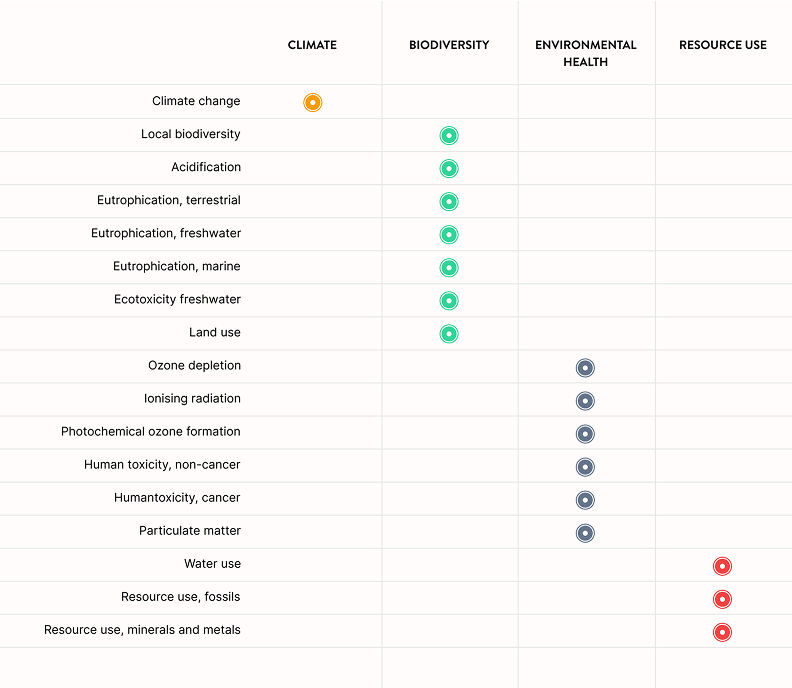
A critical benefit of conducting an LCA is getting a 360-degree vision on a product’s environmental footprint while also avoiding the “carbon tunnel vision”, getting the opportunity to gain insight into over 8 environmental indicators. While not mandatory, these categories can help textile brands and suppliers for an in-depth reporting.
- Climate Change (Global Warming Potential) – Measures GHG emissions that contribute to global warming.
- Water Use & Eutrophication – Evaluates freshwater consumption and the release of pollutants that can degrade water quality and ecosystems.
- Land Use & Biodiversity Impact – Assesses the effects of raw material extraction and agricultural practices on ecosystems and wildlife habitats.
- Resource Depletion (Fossil & Mineral Use) – Tracks consumption of non-renewable resources like fossil fuels and rare minerals.
- Acidification & Air Pollution – Examines emissions that lead to acid rain, respiratory issues, and other environmental degradation.
- Ecotoxicity & Human Toxicity – Measures the potential harm caused by hazardous chemicals to both ecosystems and human health.
- Ozone Depletion – Identifies emissions that contribute to the thinning of the ozone layer, increasing exposure to harmful UV radiation. Using the PEF methodology ensures that all significant environmental effects are considered, rather than focusing solely on carbon emissions.
F. Why LCA is a Game-Changer for the Textile Industry
- Regulatory compliance: The EU and other regulatory bodies increasingly require LCAs for transparency and green claims verification. An LCA report is a crucial beginning to a brand's regulatory journey. Upon stakeholder need, it can further be verified, published and linked to the creation of a Digital Passport Product.
- Supply chain optimization: LCA throws light into the health of a supply chain and helps brands identify high footprint hotspots, thereby being able to prioritize on identifying and engaging with suppliers who believe in the same values as them.
- Product development: A comparison between the cradle to grave and cradle to gate assessment helps suppliers and brands decide whether the footprint is higher on which side of the supply chain. This ensures a guided decision-making to adopt more eco-friendly materials and processes.
- Consumer trust: LCA reports can help brands enhance their credibility by providing transparent environmental data.
- Raw Material Extraction: Cotton farming, water usage, and pesticide impact.
- Manufacturing: Energy-intensive processes like spinning, dyeing, and finishing.
- Transportation: Carbon emissions from local and global logistics.
- 1. Raw Material Extraction: Cotton farming, water usage, and pesticide impact
- 2. Manufacturing: Energy-intensive processes like spinning, dyeing, and finishingc
- 3. Transportation: Carbon emissions from local and global logistic
- 4. Use Phase: Consumer washing, drying, and ironing habits
- 5. End-of-Life: Recycling, landfill, or incineration impacts.